
Field Notes · July 27, 2026 · 8 min · By Katarina Mbeki
Measuring your keloid between injections: a home tracking protocol
Steroid injection series are usually judged by whether the scar looks better, which is the least reliable measurement available. Three numbers and a repeatable photograph, taken the same way each month, tell you whether the series is working long before the eye can.
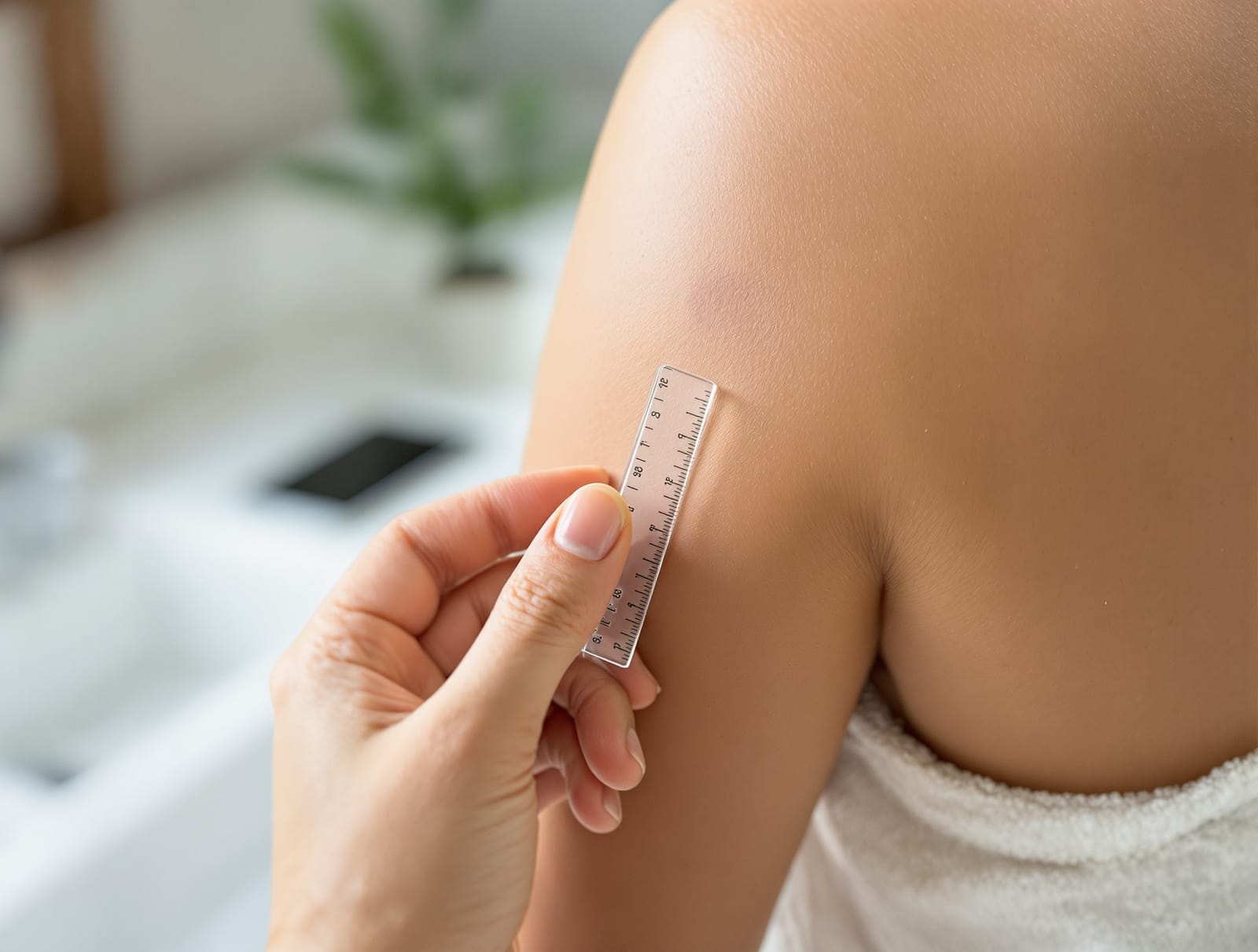
Most people who start a course of intralesional steroid injections are given a schedule and almost no way to evaluate it. Come back in four weeks. Come back in six. Somewhere around the third visit the question arrives that nobody has prepared you for, which is whether this is actually working, and the only evidence in the room is two people looking at a scar and trying to remember what it looked like in March.
Memory is unusually bad at this. Keloids change slowly, they change in three dimensions that do not change at the same rate, and the change that matters most to the patient, which is usually itch and pain, is invisible. Meanwhile the change that clinicians grade first, which is height, is the one that responds earliest to steroid and can improve substantially while the footprint on the skin has not moved at all. So it is entirely possible to be told the scar is responding, to not believe it, and for both parties to be right about different things.
The original element in this piece is a home tracking protocol built around three measurements, one standardized photograph and a symptom number, taken on the same day of the month, with an explicit reading key for what each pattern of change means and a stated threshold for when to raise the question of changing treatment. Validated clinical scar scales exist and are excellent, but they are designed for a trained observer in a clinic with calipers. Nothing in that literature has been translated into something a person can do in their own bathroom with a ruler and a phone, which is where the four weeks between appointments actually happen.
Why three numbers and not one. The published work on keloid outcome measurement makes a point that gets lost in ordinary conversation: height, surface area and pliability are separate properties that respond to treatment at separate rates and on separate timelines. Height responds to intralesional steroid first and most visibly. Surface area is far more stubborn, because the lateral border is where the active fibroblast population sits. Pliability, meaning how much the scar gives when you press it, often improves before either dimension moves. Newer instruments such as the Detroit Keloid Scale were developed precisely because a single global impression of better or worse discards most of the signal.
The measurement, done the same way every time. Take a cheap flexible plastic ruler with millimeter markings. First, measure the longest axis of the raised area, from where the skin stops being flat on one side to where it becomes flat again on the other. Write it down as L. Second, measure the widest point perpendicular to that axis and write it down as W. Third, and this is the one people skip, estimate height by resting the ruler flat across the surrounding normal skin so it bridges the scar, then reading how far the highest point rises off that plane. Two millimeters is a real number and worth recording even though it feels absurdly small.
The photograph, which is the part that actually decides things. Same room, same time of day, same light source, phone at the same distance, and the ruler in frame beside the scar every time. The ruler is not decorative. It is the scale reference that makes two photographs taken six weeks apart comparable, and without it a phone camera will silently change its framing enough to make a stable scar look like it grew or shrank. Take one straight on and one at a shallow angle across the surface, because the angled shot is the only one that shows height honestly.
The symptom number. Rate itch from zero to ten and pain from zero to ten, right then, not averaged over the month. This matters more than it sounds. The research on the burden of keloid disease found that symptom load and quality of life impact track poorly with how large the scar is, which means a scar that is barely shrinking but has stopped itching is a genuine treatment success and will be recorded as a failure if nobody wrote the number down.
The reading key. Height falling while length and width hold steady is the normal and expected shape of a response to steroid injection in the first three months. It is working. Height falling and the border also pulling in is a strong response and usually means the interval between injections can lengthen. Height flat but itch and pain dropping is a partial response, and it is worth continuing, because symptom relief frequently precedes any dimensional change. Height flat, symptoms flat and the border creeping outward across two consecutive measurements is the pattern that should prompt a conversation, because it is what non response looks like and it is the pattern most likely to be missed by eye.
The threshold. Two consecutive monthly measurements with no reduction in height and no reduction in symptom score, in a scar that is receiving injections on schedule, is the point at which the question is worth asking out loud: is it time to add or switch. That is not a demand to change treatment, and it is not a reason to stop attending. It is a specific, dated, numerical reason to ask, and it is a far better opening than saying you feel like it is not doing much. Combination approaches, and the evidence around what to add when steroid alone stalls, are covered in the treatment landscape for resistant scars, and the general point that recurrence and non response are different problems is worth keeping straight in your head before that appointment.
Where this protocol is weak, stated plainly. A plastic ruler cannot measure pliability, and pliability is one of the three properties that matters. Nothing you do at home replaces the validated instruments a clinician can apply. Height read against a bridged ruler is accurate to maybe a millimeter at best, which is fine for detecting a trend across four months and useless for detecting change across four days. And a keloid on a curved surface, an earlobe or the front of the shoulder, defeats the flat ruler entirely, in which case the angled photograph with the ruler in frame becomes the whole measurement rather than a supplement to it.
What the studies do not tell you. There is no published evidence that patients who track their own keloids do better than patients who do not. Nobody has run that trial. What is documented is that treatment decisions in this field rest heavily on serial clinical impression, that clinical impression is known to be an unreliable instrument for slow three dimensional change, and that the four to six week gap between appointments is completely unobserved. The protocol above is an attempt to put something in that gap. It costs a ruler and about ninety seconds a month.
The single most useful thing it produces is not the numbers. It is that on the day the question of switching treatments comes up, you arrive with four dated photographs taken in identical conditions and a column of figures, instead of an impression. That changes the conversation completely.